
Connected, not another silo
Your student information system stays the source of truth. A CSV or a push from your SIS keeps cohorts and enrolments current, without re-keying student data.
Bring the extract you already have
A standard extract in, cohorts kept current.
Staff run orientation, not data entry: one feed keeps rosters, terms and enrolments current, and a re-run updates records in place rather than duplicating them.
Your SIS stays the source of truth
Universities do not need another system to maintain. Your student information system already knows who is enrolled, in what, and when. First Six treats it as the source of truth and asks for the smallest useful slice of it.
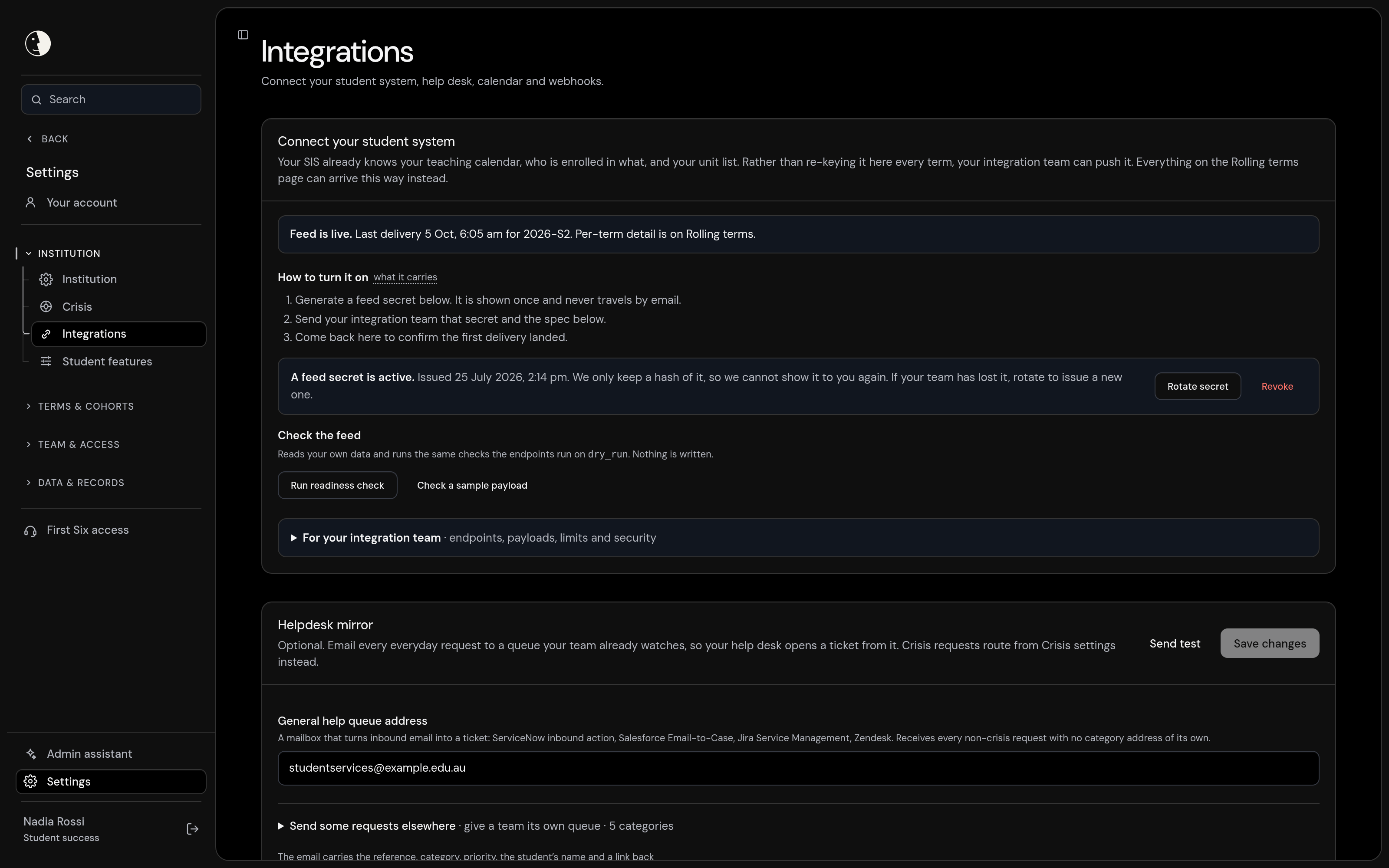
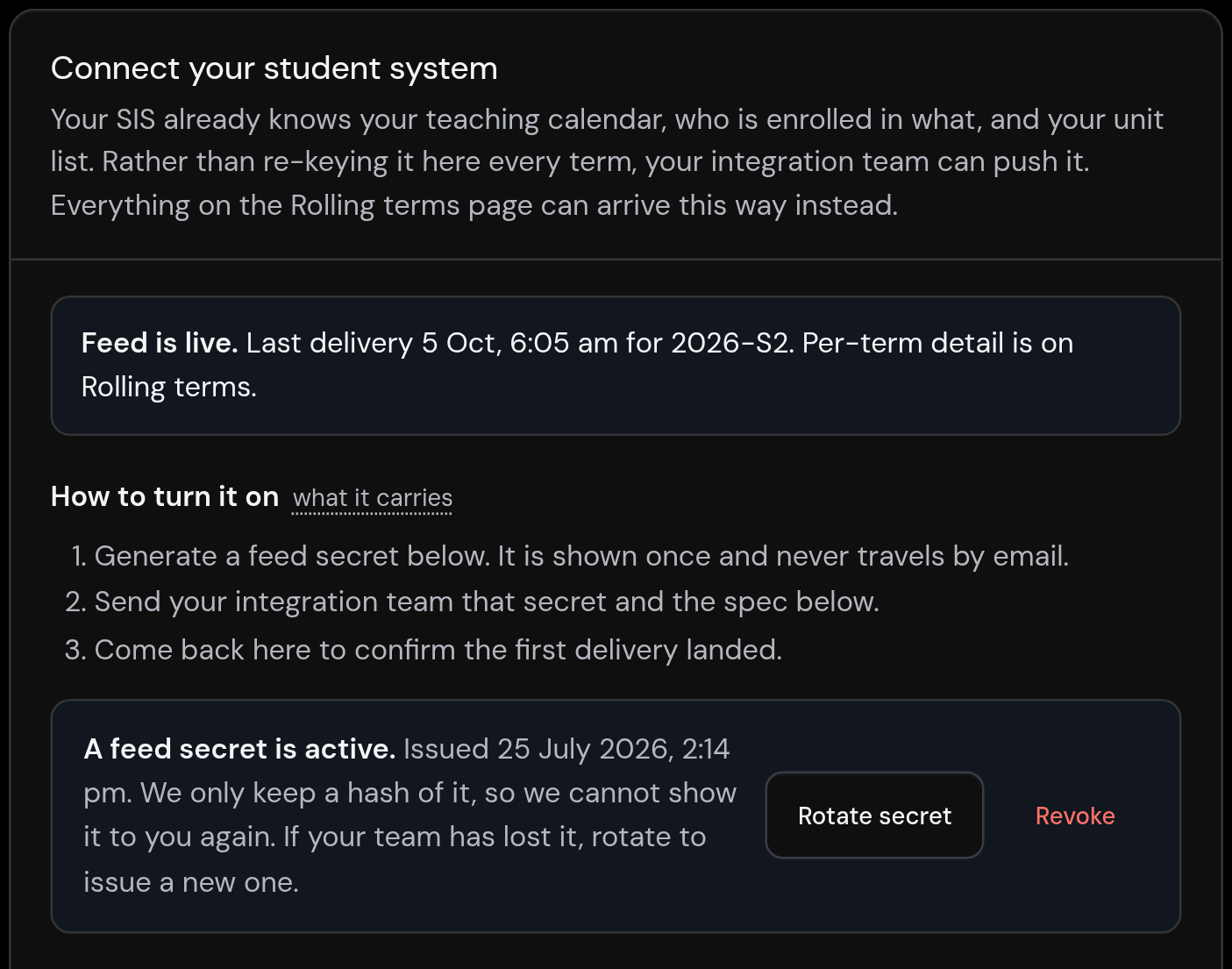
Start with a CSV roster import in the console, with no IT work. When you are ready, your side pushes JSON over HTTPS to the sync endpoints: degrees, campuses, terms and units first, then students, then enrolments. Each institution has its own feed secret, generated by your admin and stored only as a hash. A dry run validates the whole payload and writes nothing, re-runs are idempotent so nothing duplicates, each batch takes up to 5,000 students, and the console has a readiness check for the feed.
There is no product-specific connector and nothing to install in your SIS. Any system that can produce an extract can feed it, whether that is TechnologyOne, Callista, Banner, PeopleSoft or something else. First Six never pulls from your SIS.
From a standard extract to current cohorts
A standard extract in, cohorts kept current.
01
Start with a CSV
Day one needs nothing from IT: import your roster as a CSV in the console. Columns are matched by name, so an export from your SIS can usually go in as it is.
02
Connect the feed
When you are ready, push your extract to the HTTPS endpoints on the schedule that suits you, authenticated by your institution's own secret. Dry-run first; it writes nothing.
03
Updates land in place
Rosters, terms and enrolments update in place. New students are added, changed details follow, and nothing is duplicated.
04
Ready for continuing students
Enrolment rows also drive the rolling-term model, so a student with no active enrolment stops getting term prompts. That model is built but has not yet run with a real cohort.
Bring the extract you already have
Walk through the CSV import, the dry run and the readiness check with us, and bring your integration team.
Where we draw the line between support and surveillance.
Support means hearing from students, not watching them. Staff read the cohort in aggregate, every look at an individual record is logged, and nothing is inferred from clicks or log-ins. We built that line into the product itself.
Least data by design
First Six asks for the minimum slice. No grades, no fees, no financial or medical data ever leave your SIS.
Hosted in Australia
The data of record is hosted in Australia, and subprocessors are disclosed.
Scoped and audited
Feed credentials are per-institution, and staff-run imports land in a tamper-resistant audit log.
Never sold or mined
Student data is never sold or mined. It exists to support students, full stop.
Plugs into the systems you already run
SSO, roster sync, calendar integration. Your stack stays yours, and your students see only your university.
SSO, no new passwords
Sign in through your own identity provider over OpenID Connect, including Microsoft Entra ID, so there is no First Six password. SAML is a proof of concept only.
Roster sync keeps cohorts current
CSV roster import works today with no IT involvement; the HTTPS push takes roster, terms, units and enrolments, with dry-run validation.
Calendar stays theirs
iCal export to Apple, Google, or Outlook, kept current automatically.
Outbound webhooks
Subscribe your own systems to signed First Six events (request created, crisis, updated, resolved), delivered over HTTPS with an HMAC signature you verify.
Help desk & CRM (email-to-ticket)
When a student asks for help, open a ticket in the help desk your staff already watch (ServiceNow, Salesforce, Jira Service Management, Zendesk, Freshservice) via email-to-case.
Calendar (ICS)
Pull your institution's events in from a public iCalendar (.ics) feed, and give each student a private feed for Apple, Google or Outlook calendars.
Student information system
Keep cohorts current from your student information system: push roster and enrolment as JSON over HTTPS, or import a CSV with no IT work at all.
SAML 2.0
SAML 2.0 is a proof of concept and is not available for production sign-in. OpenID Connect is the production path; production SAML can be enabled within an engagement that needs it.
OpenID Connect (OIDC)
Single sign-on through your identity provider over OpenID Connect, the production sign-in path. Students and staff never have a First Six password.
Microsoft Entra ID
Single sign-on through Microsoft Entra ID using OpenID Connect, with a documented setup walkthrough. Your MFA and sign-in policies stay in Entra.
FAQ
Questions about how First Six works and what it does for your students.
Three things: your student roster (name, email, program, campus), your teaching calendar (terms with census dates), and enrolment rows (student, unit, teaching period, status). No grades, no fees, no financial or medical data.
No. Day one is a CSV import your team can run themselves. The push endpoints accept JSON over HTTPS with your institution's own secret, so they can sit behind whatever integration platform you already use. The endpoint is documented and tested but has not yet run against a university's production systems, so we plan the first sync with your team.
There is no product-specific connector: any system that can produce a standard extract can feed it, for example TechnologyOne, Callista, Banner or PeopleSoft. Your side pushes; First Six never pulls from your SIS and installs nothing inside it.
For institutions on the rolling-term model, a student with no active enrolment stops getting term prompts, and picks up again when a new enrolment arrives. That behaviour is built and tested but has not yet run with a real cohort. Removing a student's data entirely is done on your instruction.
As fresh as your feed. Changes update records in place, so add-and-drop in the first weeks lands without duplicates. You choose how often to push.