
For PVCs, DVCs (Students) and Directors of Student Success
Transition is a strategic question, not only an orientation one. First Six gives leadership an aggregate, week-by-week read on how commencing students are travelling, and evidence for your Support for Students reporting.
The challenge
Leadership answers for first-year retention, the Support for Students Policy and the student experience, but most of the data that reaches the executive is lagging: census attrition, progress rates, end-of-semester surveys and the national student experience results. By the time those arrive, the cohort they describe has moved on.
What leadership can use earlier is a leading indicator: how commencing students say they are travelling in the opening weeks, where help requests are building, and evidence that support was offered.
What First Six gives leadership, and what it does not
- Leading indicators from week two. The weekly check-in pulse with response counts, the reasons behind wobbling check-ins and the week each concern peaks, with any group under five hidden.
- Support for Students evidence. A printable, de-identified 90-day Support for Students report and a Morale report PDF for board papers, plus CSV exports and an audit trail.
- Transition as strategy. One week-by-week arc from before week 1 to after week six, written by your teams, branded as your university, and comparable cohort to cohort.
- Not a retention claim. First Six has no live student cohort yet, so there are no results to quote. Morale is a leading indicator and support activity is evidence that help was offered; neither is proof of retention. Tying them to outcomes means joining our exports with your own enrolment data.
More: Leadership and sponsor handover and Measuring impact.
Outcomes
What your team can see and do with First Six.
Signal in week two, not month twelve
See how a cohort is settling while support can still be offered, rather than in next year's attrition figures.
Evidence for the 1 March report
De-identified support activity and check-in data, framed as evidence of support offered, for your annual Support for Students report.
Cohorts compared over time
Compare this intake with the last on the same measures, at the same week, with groups under five hidden.
Claims your board can stand behind
Leading indicators and evidence of support, never a causal retention figure.
Who this is for
How First Six helps
The same six-week method, pointed at what your team needs.
01
A weekly read for the executive
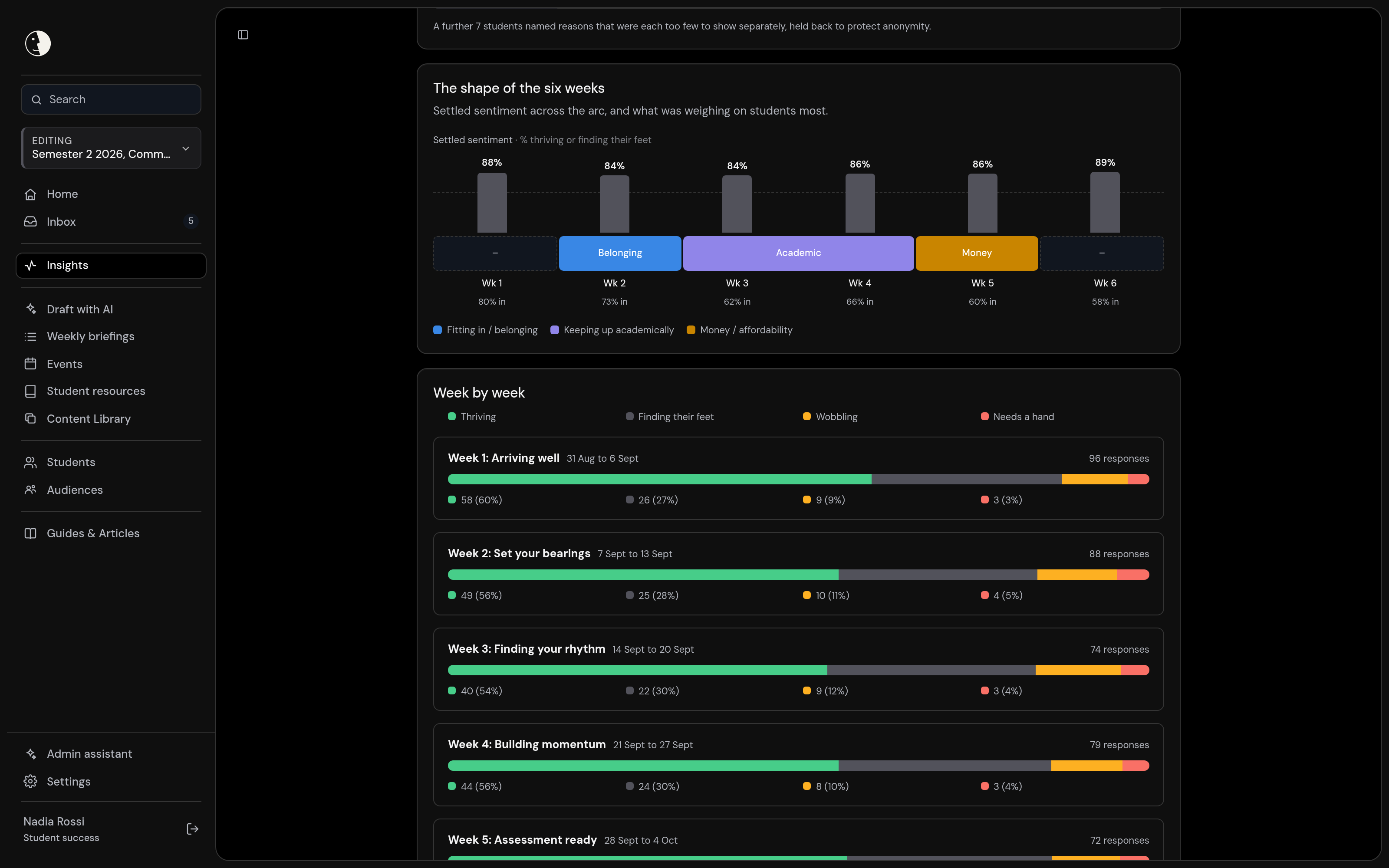
The Morale report turns weekly check-ins into a board-ready PDF: response counts, the week-by-week pulse, and small-group suppression marked where it applies.
02
Support for Students reporting
A printable, de-identified 90-day report of help requested, resolved and how quickly, with figures under five shown as Withheld.
03
Transition as strategy
One arc from before week 1 to after week six, written by your teams and compared cohort to cohort, so transition is planned rather than left to O-Week.
04
Privacy you can explain
Aggregate by default, three published Needs attention rules, every look at a student's record logged. The student app has no AI, and no student records reach any AI.
What you get with First Six
Three things this gives your team from the first week.
See it early
An aggregate, week-by-week read on how commencing students are travelling, from the first check-ins rather than the census report.
Evidence you can file
A printable Support for Students report and a Morale report PDF, de-identified, with figures under five withheld.
Claims you can defend
Leading indicators labelled as leading indicators. No predictive scoring of students, and no retention figures we cannot back.
Outbound webhooks
Subscribe your own systems to signed First Six events (request created, crisis, updated, resolved), delivered over HTTPS with an HMAC signature you verify.
Help desk & CRM (email-to-ticket)
When a student asks for help, open a ticket in the help desk your staff already watch (ServiceNow, Salesforce, Jira Service Management, Zendesk, Freshservice) via email-to-case.
Calendar (ICS)
Pull your institution's events in from a public iCalendar (.ics) feed, and give each student a private feed for Apple, Google or Outlook calendars.
Student information system
Keep cohorts current from your student information system: push roster and enrolment as JSON over HTTPS, or import a CSV with no IT work at all.
SAML 2.0
SAML 2.0 is a proof of concept and is not available for production sign-in. OpenID Connect is the production path; production SAML can be enabled within an engagement that needs it.
OpenID Connect (OIDC)
Single sign-on through your identity provider over OpenID Connect, the production sign-in path. Students and staff never have a First Six password.
Microsoft Entra ID
Single sign-on through Microsoft Entra ID using OpenID Connect, with a documented setup walkthrough. Your MFA and sign-in policies stay in Entra.
See it at cohort level
Book a demo and we'll walk through the leading indicators, the Morale report and the Support for Students report, on a sample cohort.
Frequently asked questions
What teams ask us most.
Retention itself can only be measured after census and the end of the year. What can be measured early are leading indicators: how commencing students say they are travelling, check-in participation, what is weighing on them, and how quickly help requests are answered. First Six reports those in aggregate from the first weeks, and labels them as leading indicators, not retention.
Not yet, and we will not claim it. First Six has no live student cohort, so there are no results to report. When a pilot runs, you will see leading indicators; linking them to retention means joining our exports with your own enrolment data, ideally against a comparison group.
It gives you evidence for parts of it: a weekly check-in and Needs attention list as one documented way of identifying students early, a timeline of help offered, and a printable de-identified Support for Students report. The policy, its annual review and the report you submit by 1 March stay with you.
Decisions and communication rather than configuration: sign off the crisis responder chain, agree the student communications plan, and agree what success looks like for the first cohort, such as check-in response rate and help-request resolution time. The usual path is a demo, then a pilot with one intake or faculty; onboarding is estimated at six to eight weeks, as no university has completed it yet.