
MIT's AI report warns of cognitive surrender. The case for fighting it in the first weeks of first year
MIT warns of cognitive surrender. Australian data suggests students pick AI for ease, not trust. The case for acting in the first weeks of first year.
MIT's committee on AI in teaching warns that getting the right answer from a chatbot can create “the illusion of learning” and can trigger “cognitive surrender”, a term it borrows from Wharton researchers Steven Shaw and Gideon Nave and applies to students who “fall back on AI at the first hint of struggle”. Easier to miss beside its assessment advice is its judgement that what AI does to the social side of learning, from office hours and study groups to how students work with teaching assistants, is “an even deeper challenge”. Australia's national response, led by the regulator since 2023, has been framed around assessing and assuring learning. We argue the deeper challenge is where Australian universities should now look, and that for their students it is largely decided in the first weeks of first year, before any redesigned exam can see it.
The evidence is uneven, and we say where. MIT's report points to time pressure: heavy loads push students towards efficiency, and the temptation peaks near deadlines. A 6,960-student survey at four Australian universities adds another: students who use AI for feedback trust it far less than their teachers' feedback, and value it for being easy to reach and less risky to ask. Together they suggest the pull is the cost of the human route, in time and in exposure. We argue that cost peaks in a student's first month.
What MIT actually found
The committee, co-chaired by Eric Klopfer and Sam Madden, was charged in January 2026 to assess AI use at MIT and propose a policy. Its report, dated 13 August 2026, finds that generative AI can already “produce credible solutions and provide reasonable responses to almost any written assignment in our undergraduate curriculum”.
The committee presents the harms as “early signals” that overreliance on chatbots can erode confidence and undermine mastery. In less than three years, it reports, AI has driven decreased attendance at office hours and reduced participation in online discussions, and the committee heard anecdotally of fewer in-person study groups. Students told it that the temptation to hand their thinking to AI “was greatest when they feared they would miss a deadline”. And it found students “confused and concerned about a lack of clarity, consistency and justification about the use of AI, within a given subject and across the curriculum”.
Its assessment recommendations include oral exams, semester portfolios, and out-of-class assignments paired with in-class conversations. But it warns that leaning too heavily on in-class exams reduces students' incentive to invest in the difficult, time-intensive work that builds mastery. It urges instructors to “do more than simply try to ‘AI-proof’ their classes”, because the ways AI changes the social side of learning “present an even deeper challenge”. Its answer: every subject should include a regular in-person social component, explained on the first day of class, and MIT should expand its first-year learning communities.
Australia's regulator set the assessment agenda early
On assessment, Australia's regulator moved before MIT did. TEQSA's Assessment reform for the age of artificial intelligence, whose principles were launched at its November 2023 conference, set out two guiding principles and five propositions, including a systemic, program-wide approach to assessment. In June 2024 it asked every Australian provider for an action plan on the risk generative AI poses to award integrity, and every provider responded. Its September 2025 resource, Enacting assessment reform in a time of artificial intelligence, describes three pathways for assuring learning: across a whole degree program, unit by unit, or a mix of the two. In June 2026, Assuring quality learning in a gen AI-integrated future turned to capabilities such as evaluative judgement, critical thinking and ethical reasoning.
Guidance is not reform delivered in every unit, but it shows where attention has gone. The June 2026 resource moves furthest towards the student, and evaluative judgement is exactly what cognitive surrender erodes. But the series, that resource included, is organised around assuring what students learn, which is the regulator's question: can a degree still certify what its holder knows? MIT's report points to an earlier one: what happens before any assessment, when a student is stuck and deciding who to ask.
Students trust AI feedback less, and use it anyway
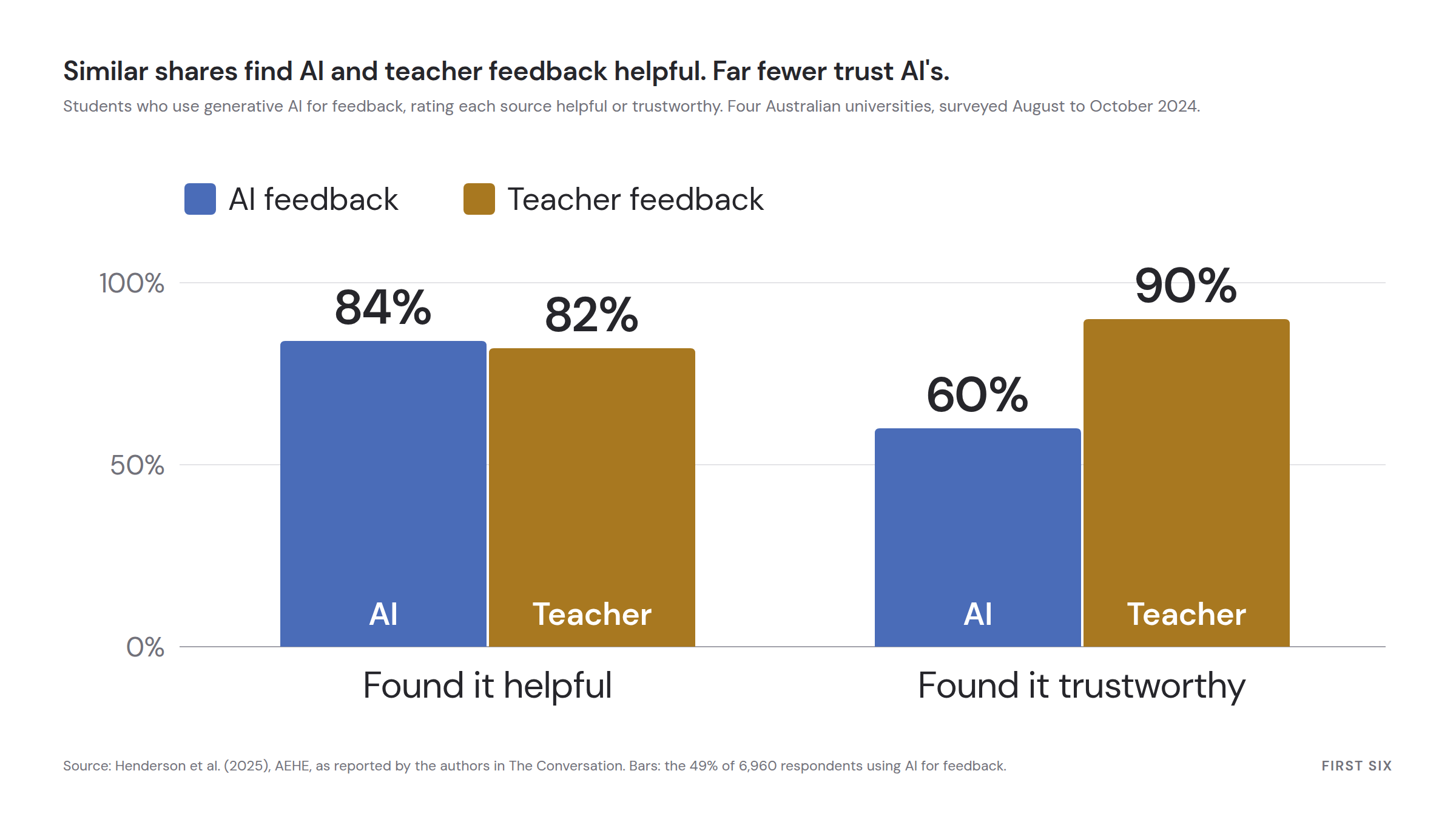
The closest Australian evidence comes from a survey of 6,960 students at Monash University, Deakin University, the University of Queensland and the University of Technology Sydney, run in August to October 2024 and published by Michael Henderson and colleagues in Assessment & Evaluation in Higher Education in 2025. It is not a first-year sample: 61 per cent of respondents were undergraduates and 58 per cent domestic. In the researchers' own summary, 49 per cent used generative AI for feedback on their work. Among them, similar shares called each source helpful: 84 per cent for AI feedback and 82 per cent for their teachers'. Trust split sharply: 90 per cent rated their teachers' feedback trustworthy, against 60 per cent for AI's. The paper weighs the same data differently, reporting teacher feedback as more helpful as well as more trustworthy, and concluding that the two “appear to serve different needs” and are “complementary but not interchangeable”.
These students use both sources, and the survey's 8,642 open-ended answers say what the machine offers: students valued AI feedback for its ease of access, timeliness, volume and understandability, and because it was perceived to be less risky than seeking feedback from teachers. The researchers describe how students can feel vulnerable taking work to a teacher, and may worry about being judged or embarrassed. Trust does shape who uses it at all: among students who did not use AI for feedback, 28 per cent gave not trusting it as a reason. For those who do use it, the draw looks like access and lower risk.
MIT's first-year physics subject is a partial counter-case. In MIT's fall 2025 semester, Physics I (8.01) ran 23 hours of office hours a week, which its instructors told MIT's student newspaper, The Tech, were full of students. Yet some first-years in the same story named ease of access as their reason for turning to AI.
The limits matter: the survey measures perceptions of feedback, not of help when stuck, and dates from 2024, long ago in this field. It cannot show what students learned or why each chose as they did. It does suggest trust is not the main draw.
Why the first weeks matter most
If surrender is a response to the cost of asking, we argue the first weeks of first year are where that cost is highest and the habit cheapest to form. MIT draws a related distinction when arguing against a single AI rule: “a first-year student building foundational skills and judgment stands in a different relationship to AI” than a doctoral candidate. A commencing student does not yet know a tutor's name, or which questions might mark them out as behind.
Building for the first six months means looking hard at when that cost is paid. The survey's finding about risk suggests the question a first-year least wants to put to a person is the one that would reveal they are behind, and their first real experience of being stuck is likely to come with the first assessed task, which is also their first deadline: the moment MIT's students said the temptation is greatest. Census date adds weight to those weeks. Commonwealth rules place it no earlier than 20 per cent of the way through a unit, and it is the last day to withdraw without a HELP debt. Where a unit sets its first assessed task in those opening weeks, the habit of who to ask forms alongside the decision about whether to stay, and we think what a student does with that first struggle becomes what they do with the next. We have argued that a similar first-contact problem helps explain the gap between how undergraduates and postgraduates rate student support: help that exists does not always reach a new student in time.
That is what assessment reform cannot reach. An oral exam in week twelve can reveal that a student surrendered in week four, too late to change what they learned.
What MIT's recommendations look like in an Australian first year
Three of MIT's recommendations have a first-year version, and each belongs in the first four weeks. MIT recommends against a one-size-fits-all AI policy, but wants a shared menu and a standardised format, and expects departments to want guidelines “largely consistent across a given major”. A first-semester student often is not yet inside a major: many take units from several schools. For them the coherence has to come from the first-year cohort: the same menu and format in every first-year unit, agreed between coordinators and explained in week one, so answers can differ by unit while the reasons stay legible.
The 8.01 policy, as quoted by The Tech, shows how to order the help: “We expect that you will find working with your peers more useful than working with AI”, but “if you want to use AI as a part of getting unstuck after first working on your own, that is fine.” It asks for the student's own attempt first, then names the help the instructors expect to work better. MIT is not against the chatbot at that moment either: it counts “support for students who might otherwise be stuck” among AI's real benefits, and objects when AI lets students “bypass the human settings” where they learn. MIT's in-person social component gives a first year the place to make that real: the first genuinely hard task of the semester met in a tutorial or timetabled study group with a person in the room, not at home the night before it is due.
Human help also has to be cheap to ask for while the habit forms: a named person each student has met before their first assessment, study groups timetabled rather than hoped for, and consultation hours presented as the normal first stop. MIT's version is its first-year learning communities. These are familiar transition ideas. What has changed is the alternative: a student who once would not have asked at all, and could see the risk in that, now gets an instant, private answer that feels like learning.
The measure that matters
Assessment reform will produce its own counts: integrity cases, oral examination results, assurance maps. The number that would show whether a university is losing its first-years to cognitive surrender is simpler and earlier: when a first-year student first got stuck this semester, who did they ask? As with the recent fall in first-year attrition, the answer lives in week-by-week first-semester data, which no annual release carries. A university that cannot answer it will find out in week twelve what the first month had already decided.